
To truly understand Viennoiserie, you have to stop thinking like a baker and start thinking like a blacksmith. In a high-end kitchen, we don’t just “mix” dough; we temper it. We manipulate fat and gluten under strict thermal conditions to create a structural marvel that shouldn’t, by the laws of physics, stay upright.
While a loaf of sourdough is a rustic, hearty soul, Viennoiserie is the high-fashion couture of the French Baking world. It is a category defined by “enrichment”—the heavy-handed addition of butter, eggs, milk, and sugar to a yeasted base. But if you’re looking into Bakery Courses, you’ll quickly find that this isn’t just about indulgence; it’s about the brutal discipline of temperature control. One degree too warm, and your layers melt into a greasy mess; one degree too cold, and your butter shatters like glass.
At the Academy of Pastry & Bakery Arts (APCA India), the Viennoiserie module is often where students have their “ego check.” You can’t rush a croissant. You can’t bully a brioche. You have to wait for the dough to tell you it’s ready.
The Croissant: A Geometry of 55 Layers
The croissant is the benchmark of any professional pastry chef. If you look at the research provided by industry legends like Jeffrey Hamelman (author of Bread: A Baker’s Book of Techniques and Recipes), you realize that the croissant is an engineering project disguised as breakfast.
The Détrempe and the Beurre
It begins with the détrempe—the base dough. Unlike pizza dough, this needs to be kept lean and cold. Then comes the “Lock-in,” where the magic of French Baking happens.
The Butter Choice: Professionals don’t use supermarket butter. We use “Dry Butter” (Beurre d’Isigny or Corman), which has an 84% fat content and a lower water ratio. This ensures that when we roll the dough, the butter stays in a continuous, plastic sheet rather than soaking into the flour.
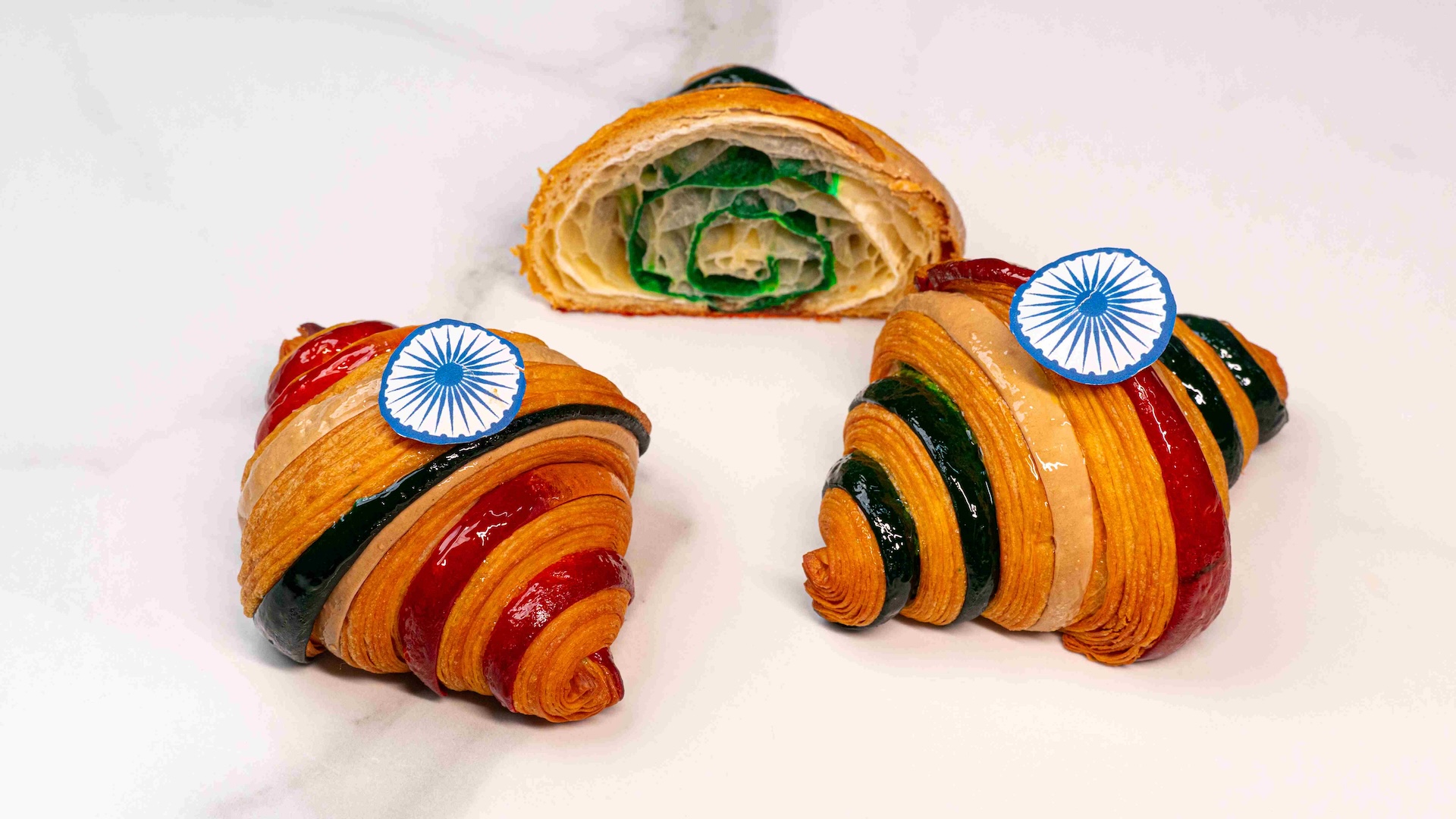
The Fold Pattern: Most professional Bakery Recipes for croissants follow a specific fold sequence. A “Single Fold” followed by a “Double Fold” creates exactly 55 layers of butter. In the heat of the oven, the water in that butter evaporates, creating steam that pushes the dough layers apart. This is what creates the “Honeycomb” or Alvéolage.
If you watch a master like Chef Jimmy Griffin on YouTube, he emphasizes the “rest.” Every time you fold the dough, the gluten gets angry. You must rest it in the fridge for at least 30 to 60 minutes to let those protein strands relax. If you don’t, the dough will shrink back, and your layers will be tough and “bready.”
Brioche: The Art of Cold Emulsion
If the croissant is a game of layers, Brioche is a game of saturation. Traditional brioche is a “high-ratio” dough, meaning the butter content can be as high as 50% to 80% of the flour weight.
The “Slow-In” Method
In any reputable Pastry & Baking Course, you’ll learn that you cannot add butter to brioche at the start.
Gluten First: You mix the flour, eggs, and yeast until you reach full gluten development. The dough should look like a smooth, elastic windowpane.
The Butter Integration: You add cold, pliable butter in small chunks. The goal is to create an emulsion. If the dough gets too hot during the mixing (friction heat), the butter will melt, the emulsion will break, and you’ll end up with a greasy cake instead of a bread.
The 24-Hour Rule: You never bake brioche the same day you mix it. It needs a minimum of 12 to 24 hours in the “retarder” (the fridge). This cold ferment develops the complex, boozy aroma of the yeast and allows the butter to solidify so the dough can be shaped into the classic Brioche à Tête.
Danish Pastry: Where Architecture Meets Flavor
The Danish Pastry is the flamboyant cousin of the croissant. While it uses a similar lamination technique, the dough itself is enriched with eggs and often spiced with cardamom, making it softer and more tender.
The Creative Shapes
In Bakery Courses, Danish day is the “design” day. You aren’t just rolling crescents; you are creating “Spandauers,” “Pinwheels,” and “Kites.”
The Filling Barrier: One of the most important professional secrets is the use of Frangipane (almond cream). Before adding fruit or jam, a layer of frangipane acts as a moisture barrier. This prevents the fruit juices from making the laminated dough soggy.
The Glaze (Nappage): A professional Danish must have a high-shine finish. We use an apricot nappage (glaze) applied while the pastry is still warm. This isn’t just for looks; it seals the pastry and keeps it fresh by preventing moisture loss.
Why “The Lab” Beats the “Home Kitchen”
You can find thousands of Bakery Recipes online, but Viennoiserie is a tactile skill that requires a professional environment. Here is what you learn when you step into a professional kitchen like APCA India:
1. The Sheeter Instinct
In a pro kitchen, we use a dough sheeter—a massive machine with rollers. It ensures that the butter and dough are flattened to a perfectly uniform thickness (usually 3.5mm). If one side is even half a millimeter thicker than the other, the croissant will “topple” in the oven. Learning to calibrate these machines is a vital industry skill.
2. The Proofing “Wobble”
Knowing when a croissant is ready to bake is the hardest skill to master. You can’t go by time because humidity and room temperature change every day. You go by the “Wobble.” If you gently shake the tray and the croissants jiggle like jelly, they are full of air and ready. If they are firm, they need more time. If they’ve deflated, you’ve over-proofed them, and the structure is ruined.
3. The Mahogany Glow
The “Parisian Glow” isn’t just about heat; it’s about the egg wash. Professionals use a “double-wash” technique. We wash once before proofing to keep the dough from drying out and forming a “skin,” and a second time right before the oven for that deep, reddish-gold color. We often add a pinch of salt to the egg wash to break down the chalazae of the egg, making it easier to brush on thinly and evenly.
Advanced Research: The Sourdough Evolution
If you look at current industry trends—especially from world-renowned chefs like Cédric Grolet or Dominique Ansel—the world of French Baking is moving away from purely commercial yeast.
Modern Viennoiserie now often incorporates a Levain (sourdough starter). This doesn’t make the croissant sour; instead, the acidity of the starter breaks down the gluten further, making the pastry much easier to digest and giving it a “creamy” aftertaste that commercial yeast alone can’t achieve. This “Long Fermentation” is a core part of advanced Bakery Courses today, requiring students to manage a living culture alongside their lamination schedule.
The Reality of the “Production Cycle”
In a professional bakery, you aren’t baking for yourself; you’re baking for a line of customers out the door. This requires mastering the Production Cycle. You learn to bake in “batches.”
Day 1: Mix the détrempe and ferment.
Day 2: Laminate (the turns) and shape.
Day 3: Proof and bake.
This 72-hour window is what allows the flavors to mature. When you see a “Freshly Baked” sign, you’re actually looking at three days of work. Professional courses teach you how to “retard” (slow down) this process in a climate-controlled fridge so that you can have fresh croissants at 7 AM without staying up all night.
Attention to Detail: The Baker’s Eye
Researching the work of chefs on platforms like Instagram or the APCA YouTube channel reveals that the modern baker is also an artist. You learn to check for:
The Shoulders: Are the “arms” of the croissant tucked in tight?
The Step: Can you see the distinct steps of the dough layers on the outside?
The Bottom: Is the base caramelized and dark, or pale and greasy? (A greasy bottom means your proofing temperature was too high and the butter leaked out).
Final Thoughts: The Soul of the Craft
Viennoiserie is a labor of love that demands you be part scientist and part athlete. It’s about the 3:00 AM starts, the cold hands, and the obsessive checking of the fridge thermometer. It is the ultimate test of a baker’s discipline.
When you slide that tray into the oven and see the “oven spring”—that sudden, dramatic expansion of the dough, it is one of the most satisfying moments in the culinary world. You aren’t just making food; you’re creating an experience. Whether you want to open your own boutique bakery or simply master the art of the perfect Sunday morning, a Bakery Course is the foundation you need.
It’s time to stop fearing the butter and start mastering the fold.