
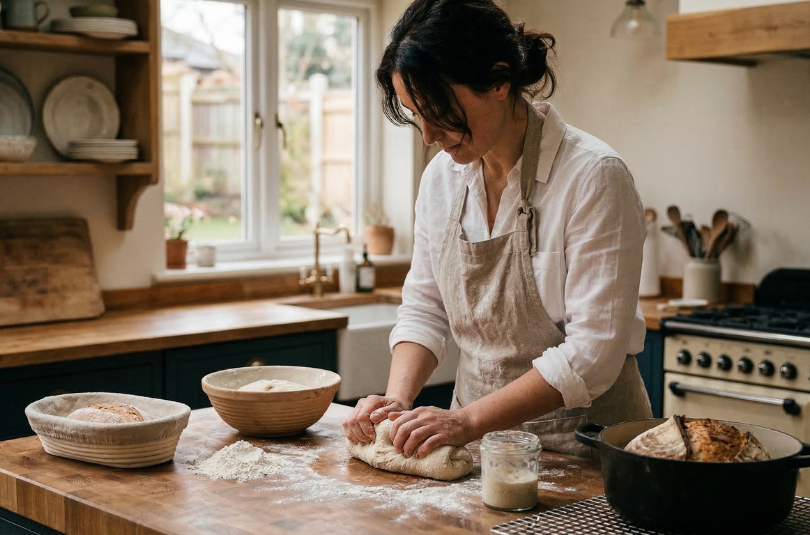
To understand Artisan Bread Recipes, you have to first stop thinking like a cook and start thinking like a biologist. In a commercial factory, bread is a dead product of mechanical speed. But in the world of the true artisan, bread is a living, breathing ecosystem. It is a slow-motion chemical interaction between wild microbes, enzymes, and the environmental variables of your specific kitchen.
When you transition from a home kitchen to a professional environment like APCA India, you learn that “Artisan” isn’t a marketing label, it’s a technical methodology. It refers to a reliance on high hydration, long fermentation, and “lean” ingredients (flour, water, salt, yeast) to create complex flavors that sugar and fat could never mimic.
Drawing from the benches of master bakers and the deep research of texts like Modernist Bread by Nathan Myhrvold and the legendary Tartine Bread by Chad Robertson, here is a deep-dive exploration of the top 10 artisan breads.
1. The Dutch Oven Country Bread (The Steam-Chamber Method)
This is the modern “Holy Grail” for home bakers. The technique was popularized by Jim Lahey’s “No-Knead” method, but the professional version involves much more than just sitting around.
- The Research: Professional deck ovens use steam injection. Home ovens vent moisture, which is the enemy of a great crust. The Dutch Oven Country Bread method uses the heavy cast iron lid to trap the steam escaping from the dough itself.
- The Industry Secret: Research from Cook’s Illustrated suggests that adding a single ice cube into the Dutch oven alongside the dough can increase the steam pressure, leading to a thinner, “glassier” crust.
2. Rustic Sourdough Bread (The 24-Hour Ferment)
Sourdough is a lesson in microbial management. Unlike commercial yeast, which is a single strain (Saccharomyces cerevisiae), a Rustic Sourdough Bread relies on a wild colony.
- The Microbial Depth: In the industry, we look at the “Lactic to Acetic Acid Ratio.” Lactic acid (produced in warm, wet conditions) gives a creamy, yogurt-like tang. Acetic acid (produced in cooler, drier conditions) gives that sharp, vinegary “San Francisco” bite.
- Pro Tip: Master bakers use a “cold retard”—putting the shaped loaf in the fridge for 12–18 hours. This slows down the yeast but allows the bacteria to keep working, deepening the flavor profile significantly.
3. Crusty French Baguette (The Alvéolage Challenge)
The baguette is the ultimate test of “Alvéolage”—the art of creating big, irregular holes in the crumb.
- The Technique: Researching the methods of French master Raymond Calvel shows that the “autolyse” (resting flour and water before mixing) is non-negotiable here. It allows the enzymes to begin breaking down the starches into sugars without the interference of salt or yeast.
- The Scoring: A professional baguette must have odd-numbered scores (usually 5 or 7). They must be overlapping by exactly one-third to ensure the bread expands upward rather than outward.
4. Focaccia Barese (The Emulsified Crust)
Unlike the dry, bread-like versions found in supermarkets, a true artisan Focaccia Barese is a “fat-saturated” masterpiece.
- The Industry Pivot: Research into the Bari region’s traditions reveals that many bakers incorporate mashed Yukon Gold potatoes into the dough. The potato starch locks in moisture, preventing the high-heat oven from drying out the crumb while the bottom “fries” in olive oil.
- The Brine: Instead of just salt, professionals use a salamoia (a brine of water and oil) poured into the dimples. This seasons the bread internally and prevents the crust from hardening too early.
5. Ciabatta (The “Slipper” Bread)
Ciabatta was actually invented in 1982 by a Venetian baker as a response to the popularity of the French baguette. It is defined by its ultra-high hydration—often 85% to 90%.
- The Struggle: At 90% hydration, the dough is basically a liquid. Professional Bakery Courses teach the “Coil Fold” method. Instead of kneading, you gently lift the dough and fold it under itself every 30 minutes to build tension without popping the massive air bubbles.
6. Pain au Levain with Toasted Seeds
This is a standard sourdough elevated by the “Maillard Reaction.”
- The Research: Seeds are “thirsty.” If you add dry seeds to dough, they will suck the moisture out of the crumb, leaving it crumbly. Industry pros use a “Soaker” seeds are soaked in water for 2 hours before being folded into the dough.
- Flavor Profile: Toasting the seeds beforehand creates pyrazines, the compounds responsible for nutty, roasty flavors that harmonize with the acidity of the sourdough.
7. Borodinsky Dark Rye
A staple of Russian artisan baking, this bread is a dark, molasses-heavy beast flavored with coriander.
- The Starch Gel: Rye has very little gluten. Instead, it relies on “pentosans” (sticky sugars). In professional courses, you learn that rye doesn’t “rise” like wheat; it “sets.” You are essentially managing a starch gel rather than a protein network.
8. Six-Strand Challah (The Enriched Artisan)
While most artisan breads are “lean” (flour, water, salt), Challah is “enriched” with egg and oil.
- The Engineering: The 6-strand braid isn’t just for show. The tension of the braid controls the “oven spring,” forcing the dough to expand in a controlled, pillowy way.
- The Research: According to Maggie Glezer in A Blessing of Bread, the secret to the glossy finish is a “double egg wash”—once before proofing and once right before the bake.
9. Roasted Garlic and Rosemary Boule
This is the “Umami Bomb” of the bread world.
- The Chemical Warning: Raw garlic contains sulfur compounds that can actually kill yeast. Professional Bakery Bread research suggests always roasting the garlic into a soft paste first. This mellows the flavor and ensures the yeast isn’t inhibited by the garlic’s natural antimicrobial properties.
10. Desem (The Whole Wheat Miracle)
Desem is a Flemish style of sourdough made from 100% whole wheat, traditionally fermented in a “flour pit” (a cool, dry environment).
- The Difference: Unlike most heavy whole wheat breads, Desem is light. This is achieved by using a “cool” fermentation, which prevents the bran from becoming too acidic and cutting the gluten strands. It is the purest expression of the grain.
The Professional Difference: What You Learn in a Course
When you follow a blog, you are guessing. When you take a Bakery Course at a place like APCA India, you are calculating.
1. Baker’s Percentages
Professionals never use “cups.” We use weights and percentages. If your flour is 100%, your water might be 75%. This allows a baker to scale a recipe from one loaf to 500 without losing the “Golden Ratio.” It turns baking from a hobby into a predictable science.
2. Temperature as an Ingredient
One of the most important metrics in a professional kitchen is DDT (Desired Dough Temperature). You have to calculate the temperature of the flour, the room, and the friction of the mixer to decide exactly how cold or hot your water should be. If your dough is 2 degrees off, your fermentation timeline is ruined.
3. The Windowpane Test
This is the visual “check” of gluten development. You pull a small piece of dough; it should stretch until it is translucent without tearing. If it tears, the “balloon” isn’t strong enough to hold the air.
The Human Element: The “Song of Bread”
There is a moment in the bakery that no AI can replicate: the “Song of Bread.” When a high-hydration loaf like Dutch Oven Country Bread is pulled from a 250°C oven and hits the cool air, the crust begins to crackle. It sounds like tiny glass windows breaking. This is the sound of the crust contracting while the crumb stays expanded. It is the indicator of a perfect bake.
- The Feel: A professional baker knows the ferment is done by the “jiggle.” A proofed dough should shake like a bowl of jelly.
- The Tap: We don’t use thermometers for bread; we tap the bottom. It should sound hollow, like a drum. This means the water has evaporated, leaving behind a structural masterpiece of air.
Why “Doing the Research” Leads Back to the “Starter”
In the world of Artisan Bread, the starter is the lineage. Some starters in San Francisco are over 150 years old. While you don’t need an ancient starter, you do need to understand “Micro-Flora.”
Research from the Sourdough Library in Belgium shows that the bacteria in your starter are actually a reflection of the baker’s hands and the local flour. Your bread is a literal snapshot of your environment. This is why a sourdough made in Kochi will never taste exactly like one made in Paris, even with the same recipe.
Final Thoughts: The Soul of the Loaf
Artisan baking is a return to a slower way of life. It’s about the flour-dusted floor, the 3 AM starts, and the obsessive pursuit of the “Perfect Crumb.” Whether you are baking at home or looking to turn it into a career through Bakery Courses, remember that bread is a living thing. It demands respect, patience, and a bit of soul.