
Taste or looks—what matters the most when people go to dine out? This question would have held no substance half a decade ago as the focus of chefs earlier was clearly aligned towards creating lip-smacking food. Today, things have changed. What diners get on their plates is not just food but a piece of art. But before that art can be plated, before the culinary voyage described by Executive Chef Momin Faqi can even begin, a chef must face the most fundamental tool of the craft: the blade.
At the Academy of Pastry and Culinary Arts (APCA), we believe that cooking is a craft, and there is no substitute for spending time on that craft. Just as a designer chooses the right brush or an architect the right pen, a chef’s relationship with their culinary knife set is deeply personal. It is the extension of your hand. If the blade is dull or the balance is off, the story you are trying to tell on the plate will be stuttered and messy. A clean brunoise or a perfectly translucent slice of ham isn’t just about skill; it’s about having the best culinary knives for the task at hand.
1. The Anatomy of the Blade: Beyond the Edge
When you’re looking to invest in a professional chefs knives set, you aren’t just buying metal; you’re buying engineering. In the kitchen, we talk about “balance” more than sharpness. A sharp knife is easy to achieve, but a balanced knife is a joy to work with for twelve hours straight.
Most high-end knives are either Forged or Stamped.
- Forged Blades: These are made from a single bar of steel, heated and hammered into shape. They have a “bolster”—that thick junction between the blade and the handle. This adds weight and balance, making them the gold standard for a culinary set.
- Stamped Blades: These are “cut out” of a sheet of steel. While modern technology has made them much better, they usually lack the weight and balance required for heavy-duty professional work.
As Sandeep Kumar, Executive Chef at Renaissance Bengaluru, points out, “Cooking is a craft.” Part of that craft is understanding the “Tang”—the part of the blade that extends into the handle. A “Full Tang” knife, where the metal goes all the way to the butt of the handle, provides the durability needed to survive the rigors of a commercial kitchen.
2. The Big Three: The Foundation of Your Culinary Knife Set
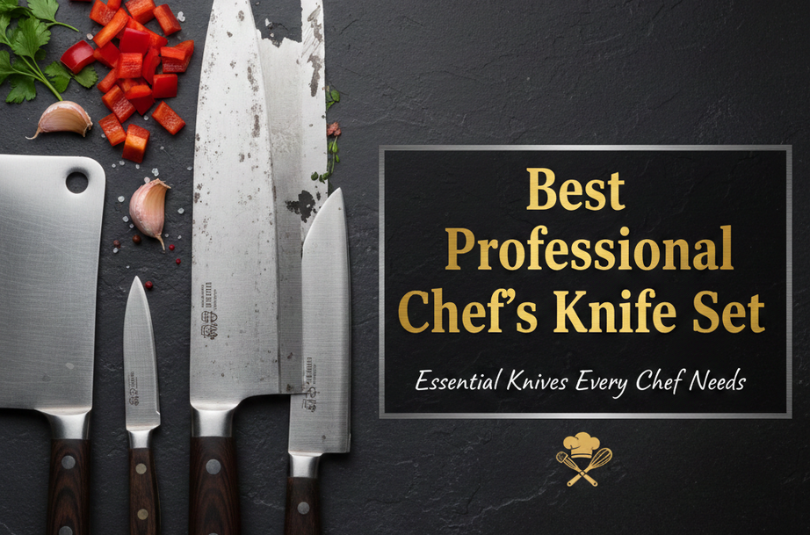
You don’t need a bag with twenty different blades. Most “Master Chefs” will tell you that 90% of their work is done with just three essential culinary knife types. If you are starting your journey at APCA India, these are the ones you should master first.
The Workhorse: The 8-Inch Chef’s Knife (Gyuto)
This is your primary tool. From dicing onions to carving a roast, the Chef’s knife is designed with a “belly”—a curved edge that allows for a rocking motion.
- The French Style: Features a straighter edge that tapers at the tip, better for a “slicing” motion.
- The German Style: Has a deeper curve, perfect for the “rocking” chop you see in high-speed prep videos.
- The Japanese Gyuto: Thinner and harder steel, allowing for a much sharper angle, though it is more brittle.
The Precision Tool: The Paring Knife
If the Chef’s knife is the broadsword, the Paring knife is the scalpel. Usually 3 to 4 inches long, it’s meant for work that happens “off the board”—peeling an apple, deveining shrimp, or fluting a mushroom. In contemporary dessert plating, this is the knife used to create those tiny, intricate garnishes that turn a dish into a piece of art.
The Specialist: The Serrated Bread Knife
Don’t let the name fool you. A serrated knife isn’t just for sourdough. Its “teeth” are essential for anything with a hard crust and a soft interior, like a delicate tomato or a layered puff pastry. In a professional chefs knives set, a long, offset serrated knife is a secret weapon for cutting clean slices of cake without compressing the sponge.
3. Japanese vs. German Steel: Which Should You Choose?
This is the great debate in every locker room at APCA. Your choice depends on your “tonality” as a chef.
| Feature | German Steel (Wüsthof, Zwilling) | Japanese Steel (Shun, Global) |
| Steel Hardness | Softer (56-58 HRC) | Harder (60-62 HRC) |
| Edge Angle | 20-22 degrees (Durable) | 12-15 degrees (Razor sharp) |
| Maintenance | Easy to hone, hard to chip | Stays sharp longer, prone to chipping |
| Weight | Heavier, more “heft” | Light, nimble, laser-like |
In professional culinary set research, we find that German knives are the “SUV” of the kitchen—they can handle bones, squash, and rough treatment. Japanese knives are the “Formula 1” cars—they require a delicate touch and a specific technique (slicing rather than chopping), but the results are undeniably cleaner.
4. Specialised Blades for the Modern Professional
As you move through your “culinary voyage,” you’ll find that the “Big Three” aren’t enough for specialized tasks.
- The Santoku: The Japanese version of a Chef’s knife. It has a “sheep’s foot” tip and a flatter edge. It’s incredible for up-and-down chopping and features “Grantons”—those little dimples on the side that prevent starchy vegetables like potatoes from sticking to the blade.
- The Boning Knife: Thin and flexible. It’s designed to “hug” the bone, allowing you to remove silver skin or separate joints with minimal waste. Every gram of meat saved is money in the restaurant’s pocket.
- The Nakiri: A rectangular blade that looks like a small meat cleaver but is actually for vegetables. If your style of cooking involves a lot of greens and fine vegetable prep, this is a game-changer for speed.
5. The Pastry Chef’s Essential Blades
At the Academy of Pastry and Culinary Arts, we have a special respect for the knives used in the bake lab. How to become a pastry chef involves mastering tools that the savory side rarely touches.
- The Palette Knife (Spatula): While not a “cutting” knife, it is essential for the “designer” aspect of plating. It’s used to smooth ganache and lift delicate sugar work.
- The Bench Scraper: A flat, rectangular piece of steel used to portion dough and scrape work surfaces.
- The Lame: A tiny razor blade used to “score” bread. This isn’t just for looks; it controls the “bloom” of the bread in the oven, ensuring the crust doesn’t crack randomly.
6. Maintenance: The Difference Between a Chef and a Cook
A chef is defined by the state of their tools. As Executive Chef Sandeep Kumar says, “There is no substitute for spending time on your craft.” That includes sharpening.
A dull knife is actually more dangerous than a sharp one. A sharp blade goes where you point it; a dull blade slips. To keep your best culinary knives in top shape, you need two tools:
- The Honing Rod: This doesn’t actually sharpen the knife. It “re-aligns” the edge. Every time your knife hits the board, the microscopic edge bends. The honing rod pushes it back into a straight line. You should use this every time you start a task.
- The Whetstone: This is where the real sharpening happens. Using different “grits” (coarseness) of stone, you actually remove metal to create a new edge. Mastering the whetstone is a meditative part of being a professional.
7. Storage and Transport: Protecting Your Investment
You’ve spent your hard-earned money on a professional chefs knives set. You cannot simply throw them in a kitchen drawer.
- Knife Rolls: Every student at APCA India starts with a knife roll. It protects the blades from banging against each other and allows you to transport your tools safely.
- Magnetic Strips: In a home kitchen, these are great for keeping knives dry and accessible.
- Blade Guards: If you must keep a knife in a drawer, use a plastic guard. An unprotected blade in a drawer is a “finger trap” waiting to happen.
8. Choosing the Perfect Handle
The handle is where the “visualiser” meets the “mechanic.”
- Wood: Beautiful and traditional, but can absorb bacteria and warp if not cared for.
- Plastic/Composite (POM): The choice of most high-volume kitchens. They are dishwasher safe (though you should never put a pro knife in a dishwasher) and extremely durable.
- Stainless Steel: Found on knives like Global. They are hygienic but can be slippery if your hands are greasy.
9. Why APCA India Focuses on the “Tool-User” Relationship
You can buy the most expensive culinary set in the world, but it won’t make you a chef. At the Academy of Pastry and Culinary Arts, we teach that the knife is an extension of your intent.
In our programs, we don’t just show you how to cut; we show you how to see. We look at the “Exclusive Journey” of an ingredient. If you are prepping a Scotch Egg with baby greens, as Chef Momin Faqi might, the way you slice that egg determines the visual story. A jagged cut ruins the aesthetics; a clean, single-motion slice shows the perfection of the soft-boiled yolk.
Our faculty helps you find the right “grip.” Whether it’s the “Pinch Grip” (holding the blade between your thumb and forefinger for maximum control) or the “Hammer Grip,” we ensure that your technique is ergonomically sound, preventing the carpal tunnel issues that plague so many veteran chefs.
10. Building Your Set Over Time
Don’t go out and buy a pre-packaged 20-piece block from a department store. Those sets are filled with knives you will never use. Instead, build your professional chefs knives set piece by piece.
Start with a high-quality 8-inch Chef’s knife. Use it until it feels like part of your arm. Then, add a Paring knife. Then, a Serrated knife. As you find your specialty—whether it’s butchery, pastry, or vegetable-forward “Garde Manger”—add the specialized tools that fit your style.
11. Final Thoughts
Taste or looks—what matters most? The answer is Balance. A dish must taste incredible, but its visual presentation is the invitation to the dance. Your knives are the tools that bridge that gap. They allow you to think like a designer and execute like a craftsman.
Choosing your culinary knife types is the first step in your own culinary voyage. Treat your steel with respect, keep it sharp, and it will serve you faithfully through the long nights and the high-pressure rushes of your career.
Ready to start your journey and learn the true art of the blade? Visit the Academy of Pastry and Culinary Arts (APCA) to explore our professional programs. From mastering basic knife skills to executing the most complex contemporary plating, we provide the stage for your creativity to thrive.