
There is a moment in every culinary arts training program when a student realises that Thai food is not a collection of recipes, but a philosophy of chaos managed by hand. It usually happens over a stone mortar and pestle. The room fills with the volatile oils of bruised lemongrass, the stinging aerosol of bird’s eye chilies, and the fermented, earthy pungency of shrimp paste.
If your experience with Thai food has been limited to plastic containers and red-tinted sauces, you haven’t yet tasted Thailand. True Thai cuisine is a high-wire act. It is the only culinary tradition that demands the palate navigate five distinct dimensions like salty, sweet, sour, spicy, and bitter in a single spoonful without any one element eclipsing the rest.
In our Thai cooking course, we peel back the layers of “takeout” culture to reveal the sophisticated, regional, and historically rich techniques that make this one of the most respected cuisines in the global gastronomic landscape.
Why We Pound, Not Pulse
In a world of high-speed blenders, why does a professional culinary skills course insist on the Krok (the stone mortar and pestle)? To answer this, we look to the research of masters like Chef David Thompson, whose work at Nahm redefined Thai food for the Michelin guide.
Thompson argues that the “shearing” action of a blender blade slices through cells, whereas the “pounding” action of a pestle ruptures them. When you pound galangal and garlic together, you aren’t just making a paste; you are creating an emulsion of essential oils. This is the bedrock of a genuine Thai curry. A machine-made paste tastes “green”; a hand-pounded paste tastes “vibrant.”
During your training, you will learn to layer your paste:
- The Dry Aromatics: Toasted cumin and coriander seeds for a smoky base.
- The Fibrous Roots: Lemongrass and galangal, sliced paper-thin before pounding to ensure no woody strands remain.
- The Fermented “MSG”: Kapi (shrimp paste) added at the very end to bind the flavors with an oceanic, umami depth.
Pad Krapow: The 45-Second Masterpiece
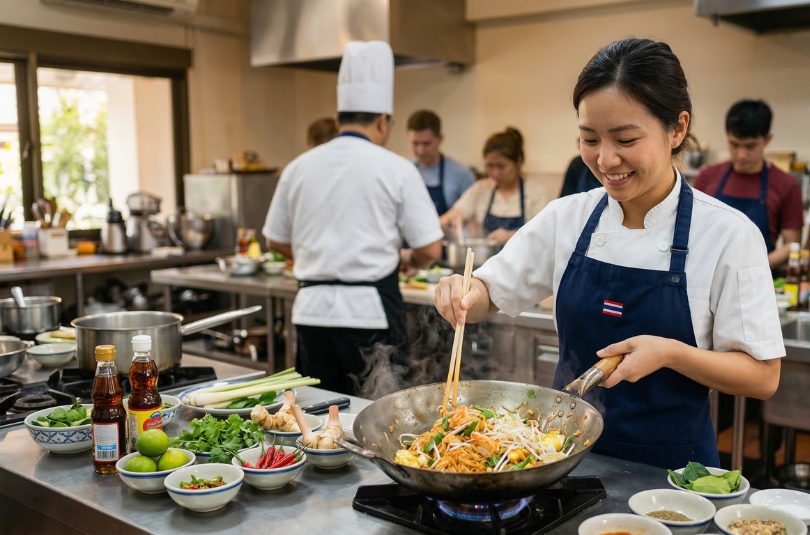
If you walk down a street in Bangkok, the rhythmic clack-clack-clack of metal spatulas hitting woks is the city’s heartbeat. Usually, they are making Thai basil chicken (Pad Krapow).
In our program, we treat this dish as a study in “Wok Hei” or “Breath of the Wok.” Most home versions fail because the pan isn’t hot enough, leading to “stewed” meat rather than seared.
The Holy Basil Research
The word Krapow literally means Holy Basil. Research into the chemical compounds of herbs shows that Holy Basil (Ocimum tenuiflorum) contains high levels of eugenol—the same compound found in cloves. This gives the Thai basil chicken recipe its signature peppery, medicinal bite. If you use Sweet Basil (the kind found in Italian pesto), you are making a different dish entirely.
The Professional Secret: We teach you to fry a “lacework” egg (Kai Dao) in a pool of hot oil until the edges are brown and shattered-crisp, while the yolk remains a molten sauce for the spicy chicken.
Ingredient Integrity: The Professional Pantry
In a culinary skills course, we move beyond the basics of the supermarket. We research the “Invisible” ingredients that create the “Thai Funk.”
- Fish Sauce (Nam Pla): Not all are created equal. We study “First Press” sauces. A high-quality fish sauce should have the color of clear amber and smell of the sea, not of rotting fish. It provides the essential glutamates that make Thai food linger on the palate.
- Galangal vs. Ginger: They are not interchangeable. Researching the chemical makeup shows that Galangal is woody and citrusy, whereas ginger is pungent and hot. Using ginger in a Tom Kha soup is a fundamental error we correct early on.
- Kaffir Lime Leaves (Makrut): These are the “perfume” of Thai food. We teach students to remove the bitter central rib and “bruise” the leaf before adding it to maximize the scent of citronella and lime.
The Pad Thai Paradox: Chemistry in a Slipper
The prawn pad thai recipe is often the most requested, yet the most misunderstood. Historically, this dish was a nationalist invention by the Thai government in the 1930s to promote rice consumption and hygiene.
In a culinary arts training program, Pad Thai is used to teach “Starch Management.”
- The Soak: You will learn why we never boil rice noodles. Boiling creates a gummy, sticky mess. Instead, we soak them in room-temperature water until they reach a “leather-like” flexibility. They must finish their cooking in the wok, drinking up the tamarind sauce.
- The “Three Pillars” Sauce: A professional sauce is a balanced reduction of tamarind pulp (sour), fish sauce (salty), and palm sugar (sweet). There is no ketchup in a real Pad Thai. The reddish hue should come from the fat of the prawns and a touch of chili paste.
Breaking the Cream: The Science of the Thai Curry
The most distinctive technique you will master in our Thai cooking course is “cracking the coconut cream.” In Western cooking, we strive for stable emulsions. In Thai curry, we deliberately break them.
When making a Green or Red curry, you don’t start with oil. You start with the thickest part of the coconut milk. You boil it until the water evaporates and the coconut oil separates from the solids. You then fry your hand-pounded paste in this natural coconut oil.
- The Result: This high-heat frying “toasts” the aromatics in the paste, releasing flavors that water-based simmering never could. This is why a professional curry has a beautiful, shimmering layer of colored oil on top, it’s a sign of a properly cooked paste.
The Regional Map: From the Jungle to the Sea
Thai cuisine is not a monolith. Our culinary skills course takes you on a geographical journey:
- The North (Lanna): Where the climate is cooler and the food is “earthy.” Think Khao Soi—a Burmese-influenced coconut curry noodle soup with pickled mustard greens.
- The Isan (Northeast): The land of the “Bitter and Bold.” Here, we explore Larb and the use of toasted rice powder (Khao Khua) to add a nutty crunch and thickening power to meat salads.
- The South: Where the spice levels reach their zenith. Southern curries like Gaeng Tai Pla are unapologetically pungent, utilizing fermented fish innards and heavy turmeric to balance the intense heat.
Why APCA India’s Part-Time Program?
We understand that passion for the culinary arts often has to balance with a professional career. Our part-time certificate program is designed for the “Serious Enthusiast.”
1. Beyond the Spoon: Sensory Calibration
A recipe says “2 tablespoons of fish sauce.” But what if your lime is extra acidic today? We teach you to calibrate your palate. You will learn the “Adjustment Loop”: if it’s too salty, you don’t add water; you add lime juice (sour) or palm sugar (sweet).
2. Knife Skills & Mise en Place
Thai cooking is 90% preparation and 10% fire. You will master the intricate julienne of kaffir lime leaves (removing the bitter rib) and the art of peeling galangal.
3. Ingredient Integrity
We research the sources. You will learn the difference between “First Press” fish sauce and the industrial versions, and why high-quality, smokey palm sugar from the Samut Songkhram province is worth the effort.
The “Taste-as-you-go” Philosophy
If you watch the research-heavy videos of Chef Pailin Chongchitnant or read the journals of Chef Andy Ricker, the message is clear: Thai food is alive. It changes with the season, the heat of the chilies, and the age of the ginger.
In our kitchen, you aren’t just a student; you are a researcher of flavor. You will learn to trust your tongue over the timer. You will learn the “Thai Funk” that perfect, slightly scary point where fermented ingredients transform into pure umami.
Conclusion
Discovering the flavors of Thai cuisine is a journey of unlearning. It is an invitation to step away from the bland and the predictable. By the end of this culinary arts training program, you won’t just be able to follow a prawn pad thai recipe; you will understand the cultural and chemical “why” behind every ingredient.
Whether you’re looking to host the ultimate dinner party or considering a future in the professional industry, our certificate program provides the technical foundation to cook with confidence, authenticity, and soul.