
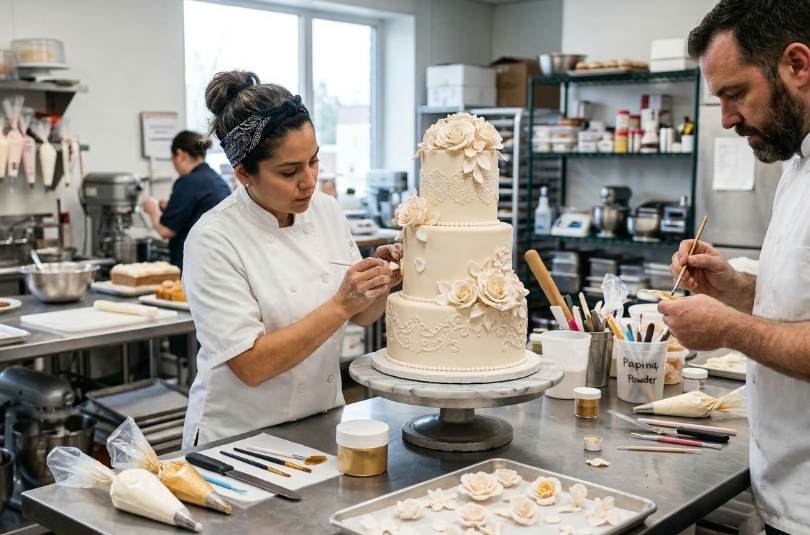
The first time you stand in front of a three-tier wedding cake, you aren’t thinking about sugar; you’re thinking about gravity. There is a terrifying, quiet tension in a pastry kitchen when the “final stack” happens. If you’ve ever watched a chef like Amaury Guichon or the instructors at APCA India, you see a level of composure that only comes from years of failing, fixing, and finally mastering the physics of sugar.
In a professional baking course, you quickly learn that a cake is not just a dessert. It is an architectural project where the “concrete” is ganache and the “steel beams” are food-grade dowels. If you’re serious about moving beyond home baking into the world of Professional Baking Courses, you have to stop thinking about recipes and start thinking about structural integrity.
The Silent Math of a Three-Tier Cake
Most people think a three-tier cake is just three cakes placed on top of one another. If you tried that with a standard sponge, the bottom layer would turn into a pancake within twenty minutes. Real Sugar Art begins with the “Internal Skeleton.”
In professional pastry circles, we talk about “The Stack.” This involves calculating the load-bearing capacity of your base.
- The Doweling Strategy: You don’t just shove sticks into a cake. You learn to create a geometric pattern of supports—usually five to seven for a large base—that transfers the weight of the upper tiers directly to the cake board, bypassing the delicate crumb entirely.
- The “Mud” vs. “Sponge” Debate: Professional research into cake textures (often referencing the heavy-hitting techniques in The Bread Baker’s Apprentice by Peter Reinhart or The Professional Pastry Chef by Bo Friberg) shows that your bottom tier needs a higher fat-to-flour ratio to maintain its shape under pressure.
Fondant: The Love-Hate Relationship with Edible Silk
Ask any student in a Pastry & Baking Course about their first time covering a square cake in fondant, and they’ll likely show you a “bruise” on their ego. Fondant is essentially an edible fabric. It’s temperamental, it hates humidity, and it remembers every mistake you’ve ever made.
Fondant Cake Decorating is less about “rolling dough” and more about “skinning” an object.
- The “Elephant Skin” Problem: If you roll fondant too slowly or in a room that is too dry, it cracks at the edges. This is known as elephant skin. Professionals learn to “massage” the sugar paste back to life using a tiny amount of vegetable shortening—a trick passed down in kitchens long before YouTube tutorials existed.
- Razor-Sharp Edges: That “upscale” look you see on high-end cakes isn’t achieved with the fondant alone. It’s achieved by creating a “box” of chilled chocolate ganache underneath. By the time you drape the fondant, you’re essentially shrink-wrapping a solid, frozen structure.
Sugar Art: The Botany of a Pastry Chef
There is a specific kind of madness involved in making gumpaste flowers. You spend six hours making a single peony, petal by petal, knowing it will likely be smashed or thrown away after the event. But this is where the “Art” in Sugar Art truly lives.
When you study at an academy like APCA India, you don’t just “make a flower.” You study botany.
- Veining and Shading: You use silicone veiners to imprint the “DNA” of a leaf onto sugar. Then, using petal dusts (essentially edible chalk), you build layers of color. A real rose isn’t just red; it’s deep burgundy at the base, fading into a bruised pink at the tips, with a hint of green at the sepals.
- The Isomalt Heat: Then there’s Isomalt. Working with this sugar substitute is like working with molten glass. You wear double gloves, you work under heat lamps, and you learn to blow “sugar bubbles” that are as thin as a Christmas ornament. It’s dangerous, high-temperature work that requires the steady hand of a jeweler.
The Narrative of the Plate: Why Aesthetics Matter
Executive chefs like Momin Faqi have often spoken about the “Culinary Voyage.” This isn’t just “chef-speak.” It refers to the psychological impact of a dish. When a guest walks into a ballroom and sees a three-tier cake, they are experiencing a visual climax before they ever taste the sugar.
In a professional baking course, you learn that you are a visualizer. You are creating a centerpiece for the most important day of someone’s life. If the gold leaf is crooked or the fondant has a fingerprint on it, the “story” of the cake is broken.
- The Research of Design: Many top-tier pastry chefs actually study architecture and fashion. They look at the ruffles on a Vera Wang gown or the clean lines of a brutalist building to find inspiration for their textures.
- The Transport Logistics: One of the most “human” parts of the job that people rarely talk about is the delivery. Driving a tiered cake across a city like Mumbai or Delhi is a high-stress operation. You learn to pack “emergency kits” (extra icing, spare flowers, a palette knife) because, in the real world, things break.
Why “Doing the Research” Separates You from the Crowd
You can find a recipe for fondant anywhere. What you can’t find is the instinct of a chef. That only comes from the “lab work” inside a Pastry & Baking Course.
- Science of Humidity: Why does fondant “sweat”? Because sugar is hygroscopic, it pulls moisture from the air. In a professional setting, you learn to manage the dew point of your kitchen.
- The Flavor Balance: A big mistake amateurs make is making the cake look beautiful but taste like cardboard. Professionals use “soaking syrups” (a 1:1 ratio of sugar and water, often infused with vanilla or liqueur) to keep the cake moist inside its fondant shell for days.
The Psychology of the “Centerpiece”
Beyond the flour and the dowels, there is a psychological weight to a three-tier cake that most amateur bakers overlook. In a high-pressure pastry & baking course, you aren’t just taught to bake; you are taught to manage expectations. A wedding cake is rarely just a dessert; it is a symbol of a family’s status, a couple’s journey, and a massive financial investment. When a student at APCA India begins their first major project, the first thing they have to master isn’t the whisk—it’s the sketchpad.
Professional chefs like Ron Ben-Israel or Maggie Austin don’t start with an oven; they start with a blueprint. They research the venue’s lighting, the humidity of the reception hall, and even the fabric of the bride’s gown. Why? Because Fondant Cake Decorating is essentially “edible architecture.” If the room is lit with warm amber LEDs, a pure white fondant might look sickly yellow. If the venue is an outdoor garden in the peak of an Indian summer, that fondant needs a higher concentration of stabilizers to prevent it from “weeping.” This level of foresight is what separates a professional from a hobbyist. It’s the difference between a cake that survives the night and one that becomes a tragic viral video of a collapsing tower.
The Unspoken Struggle: Transport and the “Crash Kit”
One of the most human, least “glamorous” parts of a Professional Baking Course is the module on logistics. You can spend eighty hours hand-sculpting gumpaste orchids, but if you don’t know how to drive them across a city like Delhi or Bangalore, those hours are wasted in the first pothole.
Every seasoned pastry chef carries what we call a “Crash Kit.” Inside this box is the frantic reality of Sugar Art:
- A “Spare” Rose: Because a waiter will inevitably bump the table.
- Royal Icing in a Piping Bag: To “glue” back any ornaments that shivered off during the drive.
- A Heat Gun or Blowtorch: To smooth out any condensation or “sweat” marks that appear on the fondant as it adjusts from a chilled delivery van to a humid ballroom.
This is the reality of the trade. It’s messy, it’s stressful, and it requires a level of grit that isn’t found in a recipe book. You learn to handle the “culinary voyage” not just on the plate, but in the back of a delivery truck
Final Thoughts: The Soul in the Sugar
At the end of the day, all the technical research, the burnt fingers from Isomalt, and the late nights spent doweling tiers come down to a single moment: the gasp of the crowd.
When you choose a Baking Course at a place like APCA, you aren’t just learning to bake. You are joining a lineage of craftsmen who believe that food should be an experience. You are learning to be an architect, a painter, and a scientist all at once.
It is a grueling, expensive, and sometimes heartbreaking craft. But when you stand back and look at a finished, 1700-word story told in sugar and flour, you realize that you aren’t just a baker. You are a creator of memories.