
If you walk into a high-end patisserie, the display case looks like a battlefield of terminology. To the uninitiated, everything is just “cake” or “pie.” But for a pastry student, the distinction between a Tart and a Torte is foundational. It is the difference between shortcrust and sponge; between structural snap and rich, flourless decadence.
In a Professional Pastry Course, you spend the first few weeks unlearning “home baker” habits. You realize that terms like “crust” or “filling” are far too vague. Whether you are enrolled in a Certificate Course at an institution like APCA India or are self-studying the classics, mastering these two pillars is a rite of passage. It is where you stop following recipes and start understanding the chemistry of fat, flour, and sugar.
The Tart: An Exercise in Shortcrust Architecture
A tart is defined by its “shell.” Unlike a pie, which is often served in the dish it was baked in (and usually has a flaky, messy crust), a tart is a free-standing structure. It relies on a crisp, buttery base to hold its shape after it is removed from its fluted ring.
The Technical Foundation: Pâte Sablée and Pâte Sucrée
In a professional Pastry Course, you don’t just “make dough.” You study the science of gluten inhibition. You learn that “Sablée” translates to “sandy.” The goal is a texture that snaps when bitten but melts on the tongue.
Researching the techniques of icons like Pierre Hermé reveals that the “sandy” texture isn’t an accident; it’s the result of sablage. This is the process of coating flour particles in fat before adding any liquid. This “waterproofing” prevents gluten from developing, ensuring the crust doesn’t become “bready” or tough.
- Temperature Control: You learn why the butter must remain at exactly 16°C to 18°C. If it’s too warm, it emulsifies with the flour, making the crust greasy and prone to shrinking.
- The “Blind Bake”: This is the ultimate test of a student. Using ceramic weights or beans, you bake the shell until the protein in the flour sets. This prevents the “soggy bottom” that plagues almost every amateur Tarts Recipe. Professionals often brush a thin layer of egg wash or cocoa butter on the inside of the baked shell to “seal” it against moisture.
The Filling Narrative
Once the architecture is set, the filling becomes the soul. Professional tarts usually fall into two categories:
- Baked Fillings: Think Frangipane (almond cream). In a professional setting, the frangipane must be piped in a perfect spiral to ensure even baking. The challenge is ensuring the filling sets exactly when the crust reaches a deep golden hue.
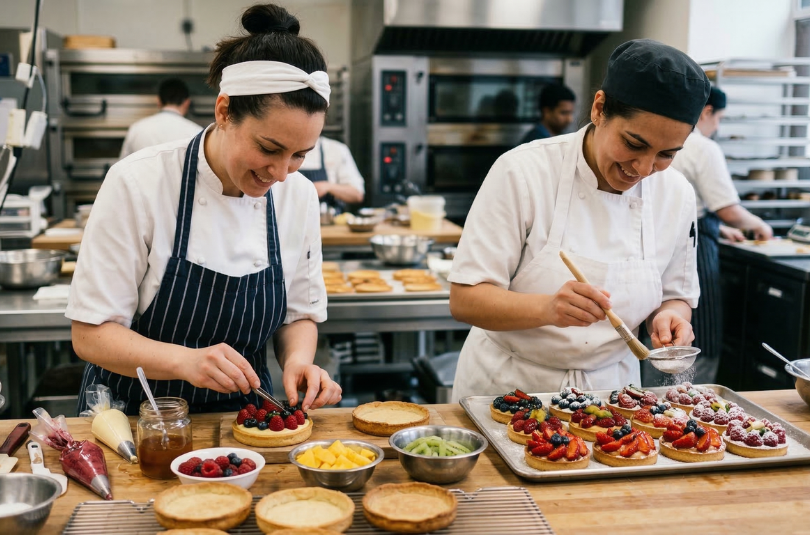
- Unbaked Fillings: A pre-baked shell filled with silky Crème Pâtissière and topped with glazed fruit. This requires a level of fruit-cutting precision that looks more like carpentry than cooking. Every strawberry or raspberry must be identical in height and angle.
The Torte: The Aristocrat of the Cake World
If a tart is about the “snap,” a Torte is about the “density.” Originating largely from Central European traditions—think the legendary Austrian Sachertorte or the Hungarian Dobos Torte, a torte is technically a cake, but with a major distinction in its DNA: it often uses little to no flour.
The Compositional Shift
In a Certificate Course, you learn that a torte replaces traditional cake flour with ground nuts (almond or hazelnut meal) or breadcrumbs. This changes the chemistry of the bake entirely.
- Protein Over Starch: Because there is less flour, there is less gluten to provide structure. The stability of a torte comes from whipped egg whites (meringue) folded gently into a rich yolk-and-chocolate base.
- The Moisture Factor: Tortes are notoriously moist. Unlike a standard sponge cake, which can dry out within hours if left uncovered, the natural oils in the ground nuts keep a torte fresh and dense for days.
- The “Soak”: Professional tortes are almost always brushed with a “soaking syrup”—a 1:1 ratio of sugar and water, often infused with Kirsch, rum, or espresso. This isn’t just for flavor; it’s to ensure the dense crumb remains tender on the palate.
The Layering Process
A torte is rarely a simple affair. It is an assembly of rich components. Take the Sachertorte, for example. It involves a dense chocolate base, a thin, sharp layer of apricot jam to provide acidity, and a “pour-over” chocolate glaze that must be perfectly smooth without the use of a spatula. Researching the archives of the Sacher Hotel in Vienna shows that the original recipe is a guarded secret, but the “human” skill lies in the temperature of the glaze; if it’s 2 degrees too cold, it won’t flow; 2 degrees too hot, and it will melt the cake.
Tarts vs. Torte: The Comparative Breakdown
| Feature | Tart | Torte |
| Primary Structure | Pastry Shell (Shortcrust) | Dense, Multi-layered Cake |
| Main Ingredient | Flour & Butter (Dough) | Ground Nuts, Eggs, Chocolate |
| Texture | Crisp, Snappy, Crumbly | Rich, Moist, Fudgy |
| Common Filling | Custard, Fresh Fruit, Lemon Curd | Ganache, Jam, Praline Cream |
| Baking Vessel | Shallow, fluted tart ring | Deep springform pan or cake ring |
The Student’s Journey: What You Learn in a Professional Course
When you move from following a random Tarts Recipe on a blog to a structured Pastry Course at a place like APCA, the focus shifts from “results” to “reproducibility.” Anyone can get lucky once; a professional must be perfect 100 times in a row.
1. The “Feel” of the Dough
You cannot learn the hydration of a Pâte Sucrée from a YouTube video. You have to feel it. In a professional kitchen, students are taught to handle dough with the “tips of their fingers” to avoid transferring body heat. You learn the “windowpane test” for gluten and the “pinch test” for tart dough.
2. The Art of Glazing (The Nappage)
A tart isn’t finished until it has a mirror-like finish. You study the “Nappage” technique using apricot glaze or neutral gel to give fruit tarts that professional “jewel-like” shine. For tortes, you master the Mirror Glaze, learning how to pour a liquid chocolate coating so that it covers the sides perfectly in one motion. If you touch it with a palette knife after it’s poured, you’ve ruined the finish.
3. Ingredient Research: The “Why”
In a Certificate Course, you dive into chemistry.
- Why use Marcona almonds for a torte? Because their higher oil content creates a silkier crumb.
- Why does European-style butter (82-84% fat) make a better tart crust? Because lower water content means less steam is released during baking, which prevents the crust from shrinking or puffing up.
The Human Element: The Chef’s Intuition
As many executive chefs emphasise, a dish is a “culinary voyage.” This is a phrase you hear often in high-end kitchens. It means that the person eating the tart should experience a sequence of events: the initial snap of the crust, the silkiness of the cream, and the bright acidity of the fruit.
In a Professional Pastry Course, you are taught to be your own harshest critic. If a tart shell is unevenly thick, it’s not just an “aesthetic” issue; it means the tart will bake unevenly, with the thin parts burning before the thick parts are cooked. This obsession with detail is what separates a “baker” from a “Pastry Chef.”
Researching the work of modern masters like Amaury Guichon shows that they treat pastry like sculpture. They might spend four hours just “lining” tart rings to ensure every single one is a perfect 2mm thick. That level of discipline is the “human” side of the craft that AI can’t replicate, which is the patience to start over when something is “good” but not “perfect.”
Transport and Logistics: The Real-World Test
One thing books rarely mention is the “stability” of these desserts. A tart is notoriously fragile. One bump in a delivery van and the crust can shatter. A torte, however, is a tank. It’s built to last.
In a professional course, you learn “The Move.” This involves learning how to slide a fragile, fruit-heavy tart onto a gold board without cracking the base. You learn about “edible glue” (usually a dab of glucose or royal icing) to keep the dessert from sliding during transport. These are the “street-smart” skills of a pastry chef.
Why “Doing the Research” Separates the Elite
Today’s industry demands more than just a good recipe. As the world becomes more visual (thanks to platforms like Instagram), the aesthetic of the tart or torte has become as important as the flavor. But a true pro knows that the flavor must be the climax of the story.
At APCA India, the curriculum is designed to bridge this gap. You don’t just learn to make things look pretty; you learn the why behind the how.
- Why does the tart shell shrink? (Usually, because the dough wasn’t rested long enough to allow the gluten to relax).
- Why does the torte sink in the middle? (Often because the egg whites were over-whipped, creating too much air that collapses in the oven).
By researching the work of world-class pastry icons and studying the chemistry of ingredients, students move away from “trial and error” and toward “predictable excellence.”
Every tart or torte tells a story and usually one of heritage, precision, and soul. When you choose a Pastry & Baking Course, you aren’t just learning to cook; you are joining a lineage of craftsmen who believe that food should be an experience.
When that tart is sliced and the crust makes that perfect “crack” sound, or when a guest takes a bite of a rich chocolate torte and the room goes silent that’s when the weeks of burnt fingers, failed doughs, and structural calculations finally pay off. It is the ultimate fusion of science and art.