
In short: Mise en place (French for “everything in its place”) means prepping your ingredients, tools and workspace before you start cooking. Professional kitchens depend on it because it speeds up service, keeps every plate consistent, lowers the risk of cuts, burns and contamination, and keeps cooks calm. Home cooks can borrow it in four steps.
On television, a restaurant kitchen is shouting, open flame and pans flying past someone’s ear. A well-run kitchen on a busy night looks different. Cooks trade short calls, hands travel a few inches between the salt and the pan, and nobody goes looking for a spoon.
That difference is settled long before the first ticket prints. The French phrase behind it is mise en place (pronounced meez ahn plahs), and chefs use it for both the prep work and the habit behind the prep work.
Mise en place is more than chopping onions early. It is a core culinary technique, taught in culinary schools and practiced in professional kitchens, and it is the working philosophy under efficiency, quality and safety there. It is also a good part of why the people inside those kitchens stay sane.
What is mise en place?
Mise en place is a French culinary term meaning “put in place” or “everything in its place.” In a professional kitchen, it means every ingredient, tool and surface a cook needs for the shift is prepped, arranged, and within reach before service starts. It also describes the mental readiness that goes with a ready station.
It helps to think of it in four layers:
| Layer | What it covers | What it looks like |
| Ingredients | Cuts of meat, sauces, spices, par-cooked items | Portioned, labeled and held at the right temperature |
| Tools | Knives, pans, tongs, tasting spoons | Sharp, clean and at arm’s reach |
| Station | Workspace, cleanliness, heat control | Clear board, wiped surfaces, burners and ovens ready |
| Mind | Expectations for the shift | A picture of the service before the first ticket prints |
The literal meaning: ingredients
The narrow definition is the one most people know. Cooks organize the ingredients they expect to use during a shift, from cuts of meat and spices to sauces and par-cooked items. Anthony Bourdain’s version in Kitchen Confidential is a station stocked with sea salt, cracked pepper, softened butter, cooking oil, wine and backups, according to Tasting Table’s summary of the book.
Tools and station readiness
Ingredients are half of it. Knives are sharp, pans sit where the cook will reach for them, tasting spoons are clean, and the board and counter are wiped down. Heat counts too. Burners and ovens are already at working temperature, so the first ticket never waits on a cold pan.
The mental state
The third layer is invisible. A cook in the mise en place mindset pictures the service before it happens: which dishes will sell, what will run low first, what needs a head start. NPR’s reporting on culinary schools notes that cooks can easily spend six hours prepping for a three-hour dinner shift, and that the mindset makes them account for every minute and every movement.
Where does mise en place come from?
The practice is tied to Georges Auguste Escoffier. After a French army career, he developed the modern brigade system at London’s Savoy Hotel in the late 19th century, splitting the kitchen into stations run by specialists. Before that, many professional kitchens were defined by disorganization and chaos. A station only works if its cook arrives ready, and mise en place is how they do it.
Why do professional kitchens depend on mise en place?
Professional kitchens depend on mise en place because it removes searching and decision-making from the moment of cooking. A prepared station makes service faster, keeps every plate consistent, lowers cut, burn, and contamination risks, and keeps the team calmer under pressure. Each benefit feeds the others.
Speed and efficiency in the restaurant workflow
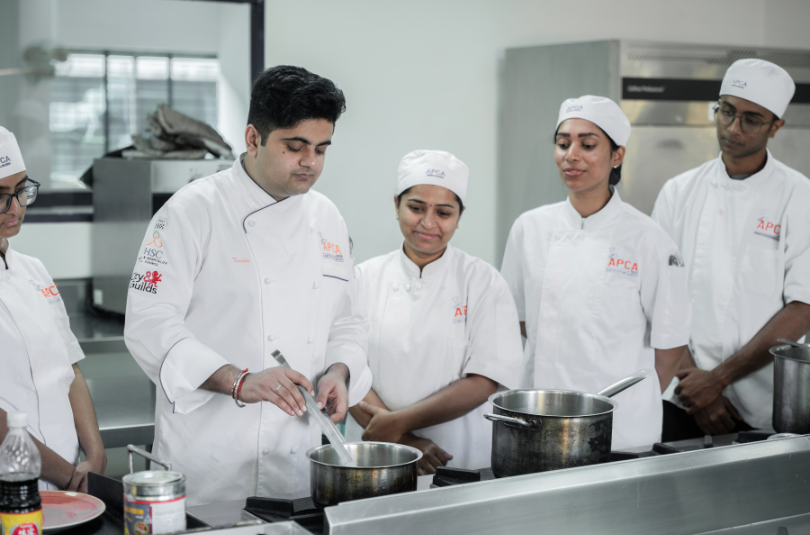
When a ticket lands, the cook should be cooking, not hunting. Dwayne LiPuma, an instructor at the Culinary Institute of America, teaches students to keep every component of a dish in one corner so a hand moves inches. He expects a cook to know where the tongs, oil, salt, and pepper are with a blindfold on.
Wasted movement is the quiet tax on every line. A few saved seconds per order add up across a night, and that is a large part of what kitchen efficiency comes down to.
Consistency and quality control
Measured, prepped ingredients mean the tenth plate of the night tastes like the first. Prepping ahead also protects the food in the pan. If a cook has to stop and chop shallots in the middle of a sauté, something burns. Cookware maker All-Clad makes the same point: with prep done, you can respond in the moment and adjust without falling behind.
It also cuts waste. The US restaurant sector generates about 11.4 million tons of food waste a year, at a cost above $25 billion, according to ReFED’s restaurant guide. The same guide estimates restaurants save roughly $8 for every $1 they invest in reducing it. Planning what you will actually use before you cut it is where that starts.
One caution: prep for the shift, not the week. Over-prepping can leave ingredients less fresh, and a rigid prep list can crowd out cooking by feel.
Safety and sanitation
An Indian kitchen has its own set of hazards: tandoors and tawas running at high heat, hot oil in deep kadhais, LPG burners and cylinders, and wet floors near a busy pass. India does not publish a national breakdown of restaurant kitchen injuries that I could find, so there is no clean figure for cuts and burns to quote. Researchers have studied the occupational health problems of restaurant workers, including those in highway restaurants in Pune. A tidy station cannot remove these risks, but it takes away some of what causes them: the knife balanced on a crowded board, the reach across a hot tawa for a ladle that belonged on the other side.
Food safety is the other half, and the scale is large. India’s Health Ministry has estimated the economic cost of foodborne disease at about USD 15 billion a year, and FoodNavigator has reported projections that foodborne illness will affect 170 million people by 2030. Restaurants fall under FSSAI hygiene rules, with Schedule 4, Part V covering catering and food service. Those rules deal with personal hygiene, cleaning and keeping food out of the temperature danger zone, which FSSAI training material gives as roughly 5°C to 60°C. FSSAI also runs the FoSTaC programme to train food handlers and supervisors.
Working clean, a core habit of mise en place, addresses this directly. In a country where vegetarian and non-vegetarian food often share one kitchen, separate boards, knives and prep areas belong in the station setup from the start. As Dan Charnas put it in his NPR report, unclean food is dangerous and people can get sick.
Stress reduction and team harmony
A cook with a ready station is a calmer cook, and calm spreads. Greg Barr, a sous chef at Esca in Manhattan, described the working-clean setup to NPR as almost Zen-like: clean knives, clean board, clear space, clear head.
Calm also comes from shared expectations. Prep cooks stock stations to a standard, line cooks trust the stock, and the expediter is not waiting on a missing garnish. Charnas lists “call and callback” among the principles of mise en place. When a call goes out, the cook answers “heard,” and nobody has to wonder whether the order landed.
Is mise en place a way of life beyond the kitchen?
Yes. Anthony Bourdain wrote in Kitchen Confidential that “mise en place is the religion of all good line cooks,” and journalist Dan Charnas built a whole book, Work Clean, on applying the idea to any kind of work. It travels because it is about preparation and attention, not food.
Bourdain kept returning to it. In the Les Halles Cookbook, he told readers that mise en place is the foundation of professional cooking. Charnas, for his part, drew on dozens of interviews with culinary professionals, including Thomas Keller and Alfred Portale, and laid out ten principles. Among them are planning is prime, cleaning as you go, and slowing down to speed up.
Applying it to daily life
You do not need a restaurant to use the idea. A few kitchen habits translate directly:
| Kitchen habit | Everyday version |
| Prep before service | Morning routines: set out tomorrow’s clothes, bag and first task tonight |
| Clean as you go | Email management: clear your inbox and desk before you log off |
| Slow down to speed up | Project planning: list the steps and gather what you need before you start |
| Call and callback | After a meeting, confirm in writing who owns what |
Charnas proposes an end-of-day reset he calls the “Daily Meeze”: clean your space, review your list, and prep tomorrow tonight so the next morning starts without friction.
How can home cooks use mise en place?
Home cooks can use mise en place in four steps: read the whole recipe, prep and measure every ingredient before turning on the heat, clean as you go, and keep sharp tools within reach. It costs a little time up front and pays most of it back at the stove. These are simple home cooking hacks, and they work in a small kitchen.
Step 1: Read the recipe all the way through
Read the recipe from start to finish before touching an ingredient. You are looking for the fast steps, the ones where you will have no time to chop, and for any tool you have not pulled out yet.
Step 2: Prep everything before the stove goes on
This is the “cooking with bowls” method. Measure, chop and portion each ingredient into small bowls or ramekins, and group them by step or by dish, as All-Clad suggests. Line them up in the order you will use them. Keep a bowl nearby for scraps so your board stays clear.
Step 3: Clean as you go
Chef Wylie Dufresne told NPR that cleaning as you go saves time and makes life easier, and anyone who has faced a dinner-party sink would agree. Wipe the board between tasks, put lids and packaging away, and fill the sink with hot water while the pan simmers.
Step 4: Respect your tools
A dull knife slips. Sharpen or hone before you start, and set out the spoons, tongs and towels you will need within arm’s reach. Borrow LiPuma’s rule from the professional line: everything you touch often should sit where your hand already goes.
Bottom line
Mise en place is not a prep step to rush through on the way to the real cooking. It is what makes the real cooking possible, whether you are feeding a dining room of 200 or making a Tuesday dinner for your family. The payoff is the same in both: control.
So what is your biggest kitchen bottleneck: the searching, the chopping, or the cleanup? Try mise en place on your next meal and tell us in the comments how it went.
Frequently asked questions
What does mise en place mean?
Mise en place is French for “put in place” or “everything in its place.” In cooking, it means gathering, prepping, and arranging all your ingredients and tools before you start, so that once the heat is on, the only job left is cooking. Professional kitchens also apply it to their stations and their mindset.
How do you pronounce mise en place?
It is pronounced “meez ahn plahs.” Cooks often shorten it to “the meez.” The phrase is French, but the shorthand is common in English-speaking restaurant kitchens, and you will hear it in cookbooks, cooking shows, and culinary school classrooms alike.
Why is mise en place important in a professional kitchen?
It lets cooks work faster with fewer mistakes. Prepped ingredients and a ready station mean no searching mid-service, more consistent plates, less clutter around knives and hot pans, and better timing between cooks. Chefs also say it lowers stress, because the hardest thinking is done before the rush begins.
Do home cooks need mise en place?
You do not need it for every meal, but it helps most when a recipe moves quickly, such as a stir-fry or a pan sauce. Reading the recipe, prepping ingredients first, and cleaning as you go make cooking calmer and results more consistent, even in a small kitchen.
Who invented mise en place?
There is no single credited inventor. The practice is most often linked to Georges Auguste Escoffier, who built the kitchen brigade system in the late 1800s after his army career. His system gave each cook a defined station, and a station only works if it is ready before service begins.