
Take an example of Badshah at Crawford Market who has been selling falooda since 1905. The original ingredients are saffron milk, arrowroot vermicelli that goes translucent in the cold, sabja seeds swollen with water, a scoop of kulfi sitting on top going soft at the edges while you eat fast enough to keep it from melting into the glass. The man who wrote about eating it for SBS Food remembers sharing one glass with his brother, their mother watching to make sure the division was equal. That detail says more about what frozen desserts actually are than any recipe can.
They are memories before they are technique. They are a specific summer, a specific lane, a specific cart with a brass bell. And then when you are training in a serious pastry kitchen, you find out that the memory was built on centuries of accumulated problem-solving, and that the dessert your grandmother bought from the kulfiwallah on his bicycle was technically more sophisticated than most things a home cook attempts today.
This is what makes frozen desserts worth studying seriously. The history is long and specific, the science underneath them is real and demanding, and the skills required to make them professionally are things you can only learn by making them, badly first, then less badly, then correctly.
Why Kulfi Was Never Indian Ice Cream
The phrase gets used constantly. Call kulfi India’s ice cream and most people nod. It is the easiest explanation and also the least useful one.
Harold McGee spent years pulling apart what ice cream is made of. His conclusion in On Food and Cooking is that ice crystals, concentrated cream, and air work together. The crystals give it body. The fat wraps around each crystal loosely enough that the whole thing stays scoopable rather than setting into a solid mass.
Kulfi has none of this. The milk is cooked in a heavy pan over a low flame for hours, stirred nearly without stopping, because if it catches the bottom even briefly, the burnt smell goes into everything and cannot come out. The water cooks off. The lactose caramelises. The proteins brown gently. No churning. No air. No ice crystals in the Western sense because the sugar concentration and fat density make large crystal formation difficult.
The result melts slower than any churned frozen dessert. This is why the kulfiwallah could sell it on a cart in Mumbai in May. It was not engineered for convenience. It was engineered, across generations and without that word, to survive heat long enough to be eaten outdoors in a country that is very often extremely hot.
The Mughal records are specific about where the ice came from. Ain-i-Akbari describes ice being brought from the mountains by relay, blocks wrapped in jute and sprinkled with saltpeter, which dissolves endothermically and pulls heat from whatever surrounds it. Fourteen stages of horses. One elephant when the route was long. Abu’l Fazl noted that two to three sets of ice cost one rupee, that prices rose in the rainy season, and that “all ranks use ice in summer; the nobles use it throughout the whole year.” All of that infrastructure existed in significant part for frozen desserts.
The kulfiwallah in Old Delhi today, the one with the insulated gunny bags whose handcart design has not been redesigned in generations, is still working with the same physics. Density over air. Slow melt over quick texture. A dessert that does not need a machine.
What the Italians Figured Out About Ice
Francesco Procopio dei Coltelli left Palermo for Paris in 1686 carrying his grandfather’s gelato-making equipment and enough ambition to open a café on the Rue de l’Ancienne Comédie. Louis XIV gave him a royal licence making him the sole producer of gelato in France. Café Procope became the most famous frozen dessert establishment in Europe. Benjamin Franklin reportedly ate there. So did Napoleon.
The Mughal kitchen went deep and dense. The Italian tradition went in the direction of control.
Harold McGee, in a lecture at the French Culinary Institute documented by food writer Ya-Roo Yang, served two kinds of ice cream side by side: one smooth and creamy in the modern sense, one deliberately crystalline, from an old French recipe called “pin ice cream” where large crystals were the point. He described eating it: “you get this prickly sensation as the crystals hit your tongue, and then as they melt, the cream flows, so with each bite you get this kind of attack, and then soothing.” It sounds strange. It was apparently delicious. The point was that ice crystal size is not a flaw to be eliminated but a variable to be chosen.
Gelato wins because it stays dense. Unlike standard ice cream machines that whip in huge amounts of air, gelato equipment churns slowly, keeping the texture tight. The reason is less heavy cream coating your taste buds and interestingly, the actual flavour hits your tongue instantly.
Sorbet is a surprising beast entirely since it has zero fat. In this case, sugar is the only tool a chef has to stop the water from turning into a solid block of ice..
Semifreddo and the Dessert That Freezes Without an Ice Cream Machine
Semifreddo sits in your freezer all night. Call it half cold if you want, that is what the name means, but pull it out in the morning and it is frozen solid. The half cold part only happens in your mouth.
Here is why. Egg whites get beaten with sugar syrup at 121 degrees Celsius and the result is Italian meringue, a stable foam where more than half the volume is air trapped inside protein. That goes into whipped cream, into a mould, into the freezer. The cold preserves what the whipping already built. Churned ice cream has more free water, so more crystals form and the coldness is something you actually feel on your tongue. Semifreddo has less free water, fewer crystals, and when a spoonful of it melts it just goes, no graininess, no real sense of eating something frozen.
The loaf shape is not a style choice. It is the only shape that works. Same with serving it on a plate rather than in a bowl. The physics of how it is made determine both.
You slice it because it is a loaf. You serve it on a plate because it needs to lie flat or the slice loses its edge. Neither of those decisions came from a chef deciding how it should look. They came from what the dessert physically is.
For a pastry kitchen running evening service, semifreddo is practical in ways ice cream is not. It can be made two days ahead. It slices cleanly in under a minute. It holds its structure on a warm plate for longer than churned ice cream before it starts to lose definition. These are not small considerations when a kitchen is running eighty covers and the dessert needs to be plated in thirty seconds.
Ice Cream Cake: The Frozen Dessert That Is Actually a Structural Problem
Chef Jürgen at the Institute of Culinary Education in New York built a version with three ice cream layers, pistachio, vanilla, and cherry, each separated by dacquoise, a baked almond meringue. The dacquoise is chosen specifically because its fat and sugar content keeps it pliable when frozen. A standard sponge cake goes hard as wood at minus 18 degrees. Dacquoise stays yielding because its composition is different. The ice cream layers are poured separately into a cake ring lined with acetate strips so they release cleanly. Each one freezes solid before the next layer goes in..
What Liquid Nitrogen Changed and What Is Actually Happening in Kitchens in 2025
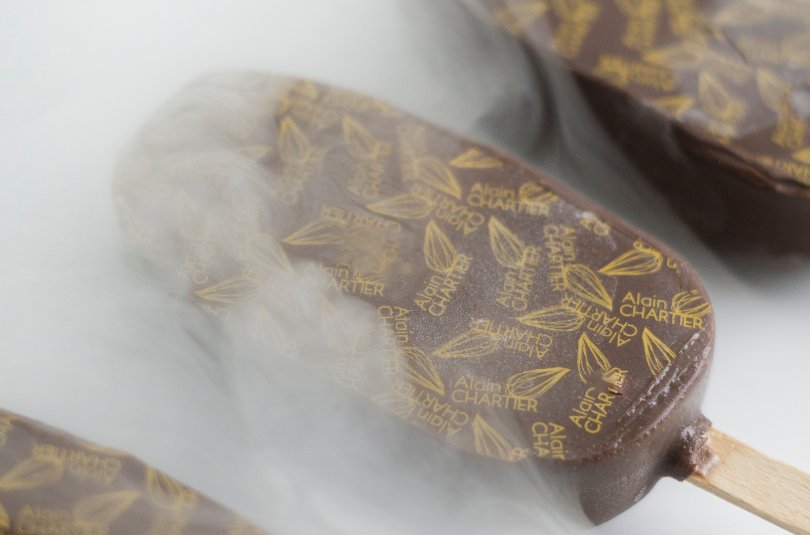
McGee noted that “using liquid nitrogen to freeze your ice cream produces a finished product of exceptional smoothness,” a result that churning at conventional temperatures cannot replicate because the crystals grow during the slower freeze.
Artem Grachev, Pastry chef at restaurant Oblaka in Kaliningrad builds frozen components tableside during service using liquid nitrogen. The guest gets something that did not exist two minutes ago. This is not performance for its own sake. It is a technique chosen because the texture it produces is not achievable any other way.
In a survey by Barry Callebaut, 11,700 people across 29 countries in 2025.Across Asia, 80 percent said they prefer frozen desserts with multiple textures in a single serving. The frozen dessert market globally is valued at USD 92 billion and growing at around 6 percent annually. What is more useful than the number is the direction of it: the growth is coming from people who want complexity, not just cold sweetness.
What Training in Frozen Desserts Actually Gives You
When you learn frozen desserts as recipes you can produce what the recipe says. When you learn them as a set of connected techniques built on the same science of crystal formation, fat content, sugar concentration, and incorporated air, you can make decisions.
A brief arrives for an outdoor event in Mumbai in April. Churned ice cream on a warm plate melts before it reaches the guest. Kulfi holds longer because it was built for exactly this situation. Semifreddo holds better than churned ice cream because its sugar and air structure resist melting differently. Knowing which to use is not common sense. It is technique knowledge.
Ninety percent of what happens at APCA is hands-on. In Mumbai, Bangalore, Gurgaon and Delhi, frozen desserts get made, not watched. Kulfi starts with a pan and milk and a low flame and patience long enough to understand what the stirring is actually doing to the liquid. Sorbet gets measured with a refractometer because that is how you know if the sugar is right, not by taste alone. Semifreddo gets built by hand. The ice cream cake has dacquoise between its layers, not sponge, and students learn the specific reason before they ever build one.
Badshah at Crawford Market has sold falooda since 1905. Same recipe. The longevity has nothing to do with nostalgia and everything to do with precision. The people making it know what each component is doing. The sabja seeds swell because they were soaked the right amount of time. The arrowroot vermicelli goes translucent because the cooking was correct. Understanding frozen desserts at that level, knowing why something works rather than just that it does, is the difference between someone who can follow a recipe and someone who can run a kitchen.