
Vinesh Gupta opened Layla in Delhi in 2017 as a Mediterranean restaurant. He spent the first few years explaining to his own guests what they were eating. Most people walked in thinking Mediterranean meant hummus, falafel, a shawarma wrap if they were feeling adventurous. “People associated Mediterranean food mostly with Lebanese and Turkish dishes,” he told Restaurant India. “But that’s not Mediterranean in its entirety.” His words. What followed, he said, was a long slow process of helping diners unlearn what they assumed and actually taste what was in front of them.
Eight years later the conversation has shifted. According to Zomato’s 2024 Food Trends Snapshot, Mediterranean is one of the strongest-growth international cuisine categories across Indian metros. Restaurant openings in the global cuisine category have grown 22 percent since 2022 and the bulk of that growth is coming from Mediterranean and Middle Eastern concepts. Diners who once thought they were eating Mediterranean food because they ordered a pita wrap are now asking for fattoush, mandi, Greek-style seafood, Levantine mezze spreads. Chef Umesh Jaiswal, Executive Sous Chef at The Westin Hyderabad Mindspace, put it simply: “Diners who’ve experienced shawarma stalls, mezze platters, and baklava cafés abroad now seek to recreate those flavors at home.”
All of which creates an obvious opportunity and an obvious problem. The opportunity: more kitchens across India need chefs who actually know Mediterranean food. The problem: most of them don’t.
A Little History That Explains a Lot of Technique
Before anything else, a brief note on where this cuisine actually comes from, because it matters for how you cook it.
There was no such thing as Mediterranean cuisine as a category until Elizabeth David named it in her 1950 book. She had spent the war years in France, Italy, Greece, and Egypt, came back to a London where the food was, in her own description, flour-and-water soup seasoned with pepper, and wrote the book partly as an act of personal sanity. Her publisher wanted to call it The Blue Train Cookery Book. She refused. The book asked for olive oil, garlic, fresh basil, saffron, and aubergines. Most of these were not in British shops. That did not stop it from changing how a generation cooked.
What David was arguing was that the countries bordering the Mediterranean, despite their obvious differences, shared a kitchen logic. Olive oil instead of butter. Wheat in some form at every table. The sea as the main source of protein. Vegetables and legumes doing most of the heavy lifting. Meat eaten rarely because it was expensive and livestock were too useful to slaughter for dinner.
Then in the 7th century onwards, Arab expansion brought rice, citrus fruits, eggplant, saffron, cinnamon, almonds, and spinach into Spain, Sicily, and North Africa. Everything that now reads as core Mediterranean arrived through this movement of people and ingredients. The tagine of Morocco, slow lamb with dried apricots and preserved lemon in a clay pot, exists because of that exchange. The preserved lemon itself is a technology worth understanding before you try to use it in a kitchen.
Moroccan preserved lemons are made by packing whole citrus in coarse sea salt and their own juice in a sealed jar, leaving them somewhere cool for four weeks minimum, often longer. What happens is not simply pickling. The acid in the lemon juice and the salt together create an environment that kills off harmful bacteria while the fruit slowly softens, the rind turning from sharp and bitter to something silky and complex. The flavor writer David Lebovitz described making them near the lemons of Provence and using them finely diced with roasted vegetables, or stirred into aioli as Yotam Ottolenghi does. You can buy them at specialty stores but the ones you make yourself after a month on the shelf taste cleaner and more aromatic than anything jarred. You rinse off the excess salt, discard the pulp, and use only the rind. A tagine without preserved lemon is a decent braise. With it, the dish has a sourness that goes into the back of your throat and stays.
The Mezze Table as a Masterclass in Getting Things Right
Mezze is not a course. It is an approach. Small dishes, served together, meant to be shared across a table at no particular pace. Lebanon, Turkey, Greece all have versions that differ in ways that matter. What they share is the idea that many small things made well creates something no single dish could achieve alone.
Hummus is the most instructive dish in all of Mediterranean food, at least for learning purposes. The recipe is not complex. Cooked chickpeas, tahini, olive oil, lemon juice, garlic, a little salt, maybe some of the warm cooking liquid to loosen it. The things that actually determine whether a bowl of hummus is worth eating are not in the recipe. Whether the chickpeas soaked for twelve hours before cooking. Whether each chickpea was peeled before blending, which takes time but eliminates the gritty skin texture that plagues most restaurant versions. Whether the blending happened while the chickpeas were still warm, because cold chickpeas produce a rough paste where warm ones go silky. Whether the tahini was well mixed from a new jar before it went in, because separated tahini brings in a bitterness that sits wrong.
None of this is written in the recipe. All of it is learned by making hummus badly several times and figuring out why it went wrong.
Tabbouleh has a different version of the same lesson. Outside Lebanon, it is often made as a grain salad. Bulgur wheat, some parsley and mint scattered through, lemon and oil to dress it. Traditional Lebanese tabbouleh is the opposite. It is a parsley salad. The bulgur soaks in the lemon juice and herb liquid and becomes the texture, not the point. The ratio is overwhelmingly green. Parsley that is not chopped finely enough turns to mush when the dressing goes in. The knife work required to get through that quantity of flat-leaf parsley at the right size, while keeping it fresh and not bruising the leaves, is a real skill that takes practice.
Baba ganoush starts with an eggplant held over a direct flame until the skin is completely blackened and the inside has collapsed. Not in an oven. Over fire. The char goes through the skin into the flesh, and that smokiness is what makes baba ganoush taste like anything at all. Everything else, the tahini, lemon, garlic, olive oil, is a carrier for that smoky eggplant quality. Skip the flame and do it in an oven and you have a pale, mealy dip with nothing to say for itself.
Shakshuka, Socarrat, and Why Simple Mediterranean Dishes Are Hard to Get Right
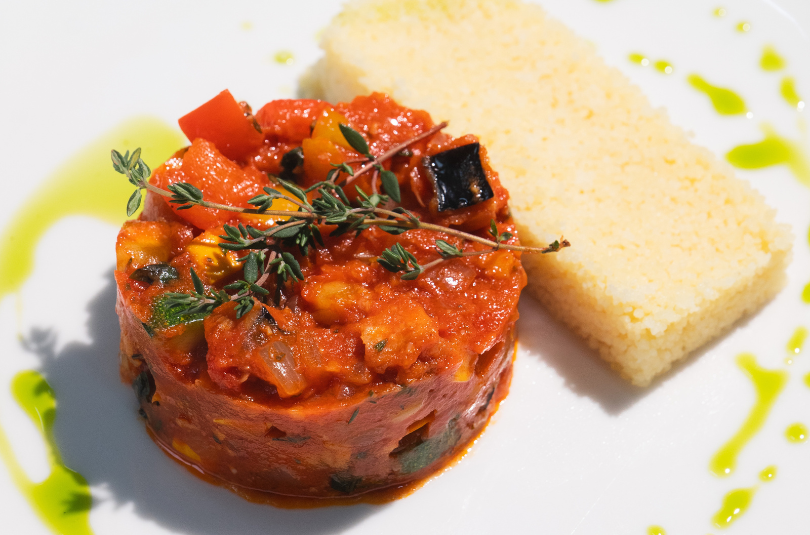
Shakshuka is the Mediterranean dish that has crossed into Indian food culture most completely. It is on café menus from Bandra to Koramangala. The dish is a tomato and pepper sauce, spiced usually with cumin, paprika, sometimes harissa, with eggs cracked in and cooked until whites are set and yolks remain runny. Served from the cast iron pan it was made in, with warm pita or bread on the side.
What most café versions get wrong is the sauce underneath the eggs. The tomatoes need time, enough time that the raw sharpness cooks off and the sauce concentrates into something rounded and deep. But not so much time that the brightness disappears. The eggs go in when the sauce is at a specific temperature. Too hot and the whites set immediately hard while the yolks overcook waiting for the whites to finish. Too cool and the whites stay wet and slippery while the yolks get chalky. Lid on, low flame, two minutes of watching. The recipe says this. Knowing what two minutes of watching actually looks and smells like is something you learn only by cooking it twenty times, ruining it several of those times, and eventually developing the instinct to pull the pan at the right moment.
Paella from Valencia is a different kind of lesson. It is cooked in a flat iron pan over wood fire until the saffron broth is absorbed into round-grain rice. The goal at the finish is socarrat, the crust that forms on the bottom layer of rice against the pan. Socarrat is not burned rice. It is the Maillard reaction at a temperature controlled precisely enough that the starches toast and develop a nutty savory flavor without going bitter. Getting it means keeping the pan completely still once the liquid goes in, reading the sounds changing at the base of the pan as the moisture drops, smelling the slight toasty note before it tips into burning. This is not something a recipe communicates. A teacher who has made paella enough times knows the moment and can describe it. Reading it in print is not the same.
The India Opportunity and What Chefs Need to Bring to It
Gupta’s restaurant Layla developed what he now calls Inditerranean cooking, blending Indian produce and sensibility with Mediterranean technique. Fiori, a glasshouse restaurant that opened near Mumbai in Lonavala in 2024, built its entire menu on vegetarian Mediterranean and European cooking. The Den in Delhi has run full Mediterranean concepts for years. These are not experiments. They are responses to real sustained demand from diners who know what they want and can tell when a kitchen does not know how to deliver it.
What those kitchens need from their chefs is not enthusiasm for the cuisine. It is the ability to make hummus that someone who has eaten it in Beirut would respect. To char an eggplant properly and know what the texture should feel like before it goes into the bowl. To build a shakshuka sauce that has depth without being muddy. To understand preserved lemon, what it is and why you use the rind and not the pulp, why a month in salt and acid changes the chemistry of the fruit and why a dish made with fresh lemon juice does not achieve the same result.
Mediterranean food looks like it should be easy because the ingredient lists are short and the preparations appear simple. That impression is what makes it a genuinely demanding cuisine to execute well. There is nowhere to hide. A grilled fish with olive oil and lemon succeeds or fails entirely on whether the fish was good, the grill was hot enough, and the oil was worth using. No sauce, no spice blend, nothing to mask what is actually happening. The cuisine punishes a lack of knowledge about ingredients more directly than most traditions do.
What Training at APCA Gives You in This Context
APCA’s culinary programmes at campuses in Mumbai, Bangalore, Gurgaon, and Delhi cover international cuisines, including Mediterranean food, as part of a full professional curriculum where 90 percent of learning happens through making things rather than observing them.
Making hummus correctly means learning to work with dried chickpeas rather than canned, understanding why hydration time matters, peeling chickpeas individually because the result is worth the time, and blending while warm. It is also learning to taste and adjust, to know when tahini is overpowering the chickpea or when lemon is cutting through rather than brightening. These are flavor decisions made through repetition.
Making shakshuka means learning heat management through a dish that reveals poor heat control immediately. Making tabbouleh means developing knife skills fine enough that parsley stays fresh after it is cut. Making baba ganoush means learning to work with direct flame and understanding what irreplaceable smokiness tastes like so you know when you have it.
Gupta spent years helping his guests unlearn what they thought Mediterranean food was. The chefs who come into his kitchen having trained in this cuisine arrive already knowing what he knows. They spent their training hours failing at hummus, overcooking shakshuka eggs, missing the socarrat on the paella, and learning from those specific failures. That practical knowledge is not something that transfers from reading about Mediterranean food. It comes from a kitchen and a teacher and enough repetition that the hands know what the recipe cannot say.